Finding Your Kin
2026
Participatory Speculative Physical-Digital Intervention
c.95d8, Hong Kong
Running the intervention FINDING YOUR KIN at c.95d8 was a meaningful opportunity to check in with my cosmovision and co-create new patterns of connection in relation to the idea of “difference.”
The driving question was ‘Can we augment the unique traits that define who we are individually to the point that we find meaningful overlaps with living organisms other than humans? And could this offer a different perspective on human ways of being and cultivate greater empathy and compassion for simply being who we are?’


I was deeply influenced by Donna Haraway’s slogan “Make Kin, Not Babies”. Her writing actively nudges us to rethink communal belonging by expanding the relationships of care that span generations and species. Echoing Donna Haraway's worldview, “Nothing in this world makes itself, and nothing grows alone", this workshop was shaped by the process of “making-with" in a community of practice. The workshop was designed to delve into personal traits and collectively exaggerate and mutate them to design entirely new organisms that embody individuals’ characteristics, which were later matched with those of existing organisms, such as a volvox or a nocturnal marsupial. This was to discover that the closest relatives in the web of life can be the strangest, most beautiful “others.”

While the main idea was shaped by Haraway’s worldview, the overarching assumption that guided my interest is Jakob von Uexküll’s foundational concept of the “Umwelt”. The term literally refers to the world that every living organism perceives through their private sensory bubbles, such as scent, light waves, or vibrations that the bodies are wired to receive. Uexküll argued that humans, with their predetermined sensories, do not see the real objective world. I thought this notion strips away anthropocentric biases to recognize that every organism occupies its own private, distinct reality based entirely on its physiological filters. This ecological framework was extended by Ed Yong’s book An Immense World, which reminded us that an animal’s extraordinary ability lies in what it cannot perceive. In the workshop, we explored not only what the new organisms experience but also what they are completely blind to or deaf to, opening up creative space to invent alternative superpowers in a world full of hidden dimensions.
GOING THROUGH SOMATIC RECONFIGURATION
For such an experience of exploring a more-than-human worldview and discovering long-lost relatives in the ecosystem, I wanted us to push ourselves out of our human-centered bubbles. Somatic movement exercises at the beginning helped us deconstruct our rigid human-ness—to become “aware that [we are] using eyes primarily,” as a participant reflected. Here, we navigated viewing our bodies not as familiar, overlooked, self-contained machines, but as a planetary landscape with fluid boundaries that meet the air and the ground—“[becoming sensitized to] feel the temperature differences throughout different parts of my body” as another participant reflected. My hope for this process would help us re-connect with our bodies, shift away from our usual perspectives on ourselves, and awaken sensitivities to discover new ways of perceiving and experiencing the world.
Through a somatic cartography activity, human bodies became fluid and highly sensitive design interfaces that actively interrogated boundaries. This inward orientation was then externalized and mirrored back through the eyes of a peer observer. By mapping the body from both a first-person experiential viewpoint and a third-person relational viewpoint, the workshop destabilized the conventional boundaries of the human body and ’self.’

FOSTERING CONNECTIONS
FOR KINSHIP
For me, the most exciting shifts happened when the workshop transitioned into its social phase. Some of the participants later reflected that they experienced a disruption to their internal self-image when confronted with how others read their appearance and behavior. For instance, a participant who saw themselves as “pointy” discovered that their partners perceived them as “smooth and rounded”. While this relational friction did not necessarily alter their sense of core identity, it significantly broadened their perspectives. It was interesting that the social process of identifying personal traits and sequentially amalgamating them in their new, speculative organisms captured only part of the participants’ complete selves, which they might not have been aware of. It was exciting when some participants mentioned they would revisit the process to discover what other traits might surface.


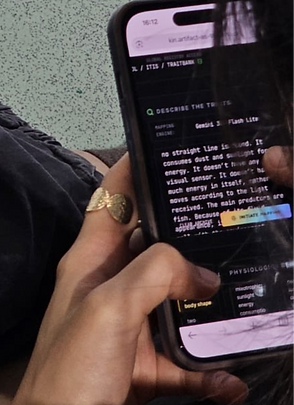
Newly formed kinship with both humans and non-humans came alive through the active exchange of ideas and materials, through a mix of physical, digital, and textual touchpoints. While the clay modeling of the new organisms helped some people feel an immediate, physical empathy for other living beings, it was the Kinship Compass, the app I created for more-than-human matching based on existing scientific and behavioral datasets, that deepened awareness and a sense of connectedness. Between humans, the sense of affinity seemed to be forged through simple interactions: co-generating clay forms in the style of exquisite corpse through interpreting each other’s trait inventories, sticking post-it notes on the shared traits with each other's more-than-human kins to say, "I resonate with this,” and tossing the tie-dyed yarn to map the greater connections.